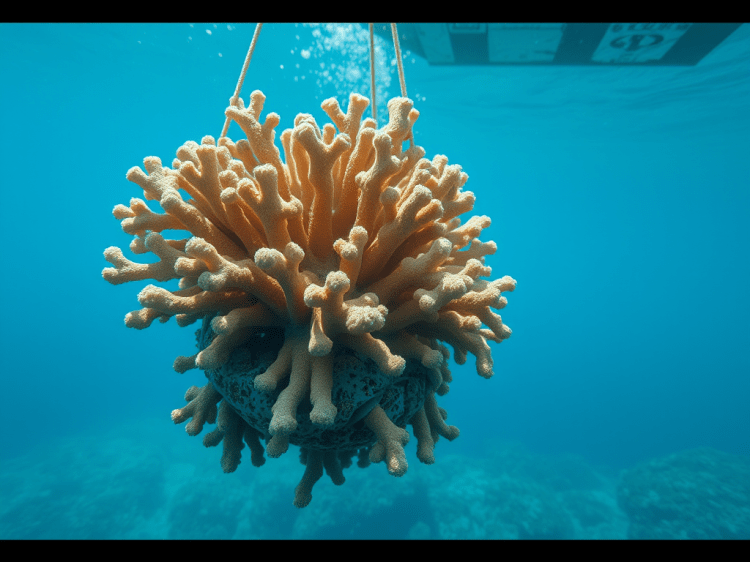
When the ocean’s coral turn white, it’s easy to assume the worst for the world’s coral reefs.
But a new study from the University of Technology Sydney brings a nuanced message: bleaching is not death, and some simple interventions might help buy time for reefs facing increasingly frequent marine heatwaves.
In the summer of 2024, as the Great Barrier Reef endured yet another mass bleaching event, researchers led by Paige Strudwick and colleagues from the Climate Change Cluster at the University of Technology Sydney set out to test whether shading or lowering coral nurseries could protect these vital reef “seed banks” . Their findings, published in Coral Reefs in April 2025, challenge some common assumptions about coral rescue efforts and highlight the importance of local context in reef restoration strategies.
Coral bleaching—when corals expel their colorful symbiotic algae under stress—has become a global crisis, threatening the biodiversity and fisheries that depend on healthy reefs. Yet, many corals can recover if conditions improve. Understanding how to help them survive these tough spells is crucial as climate change drives more frequent and severe marine heatwaves.
Restoration practitioners have increasingly turned to coral nurseries—underwater gardens where young corals are grown before being transplanted to damaged reefs. But these nurseries, too, are vulnerable to the same heat and light stress that afflict natural reefs. This study is among the first to rigorously test whether local interventions—like providing shade or moving nurseries to deeper, cooler waters—can tip the balance in corals’ favor during extreme events.
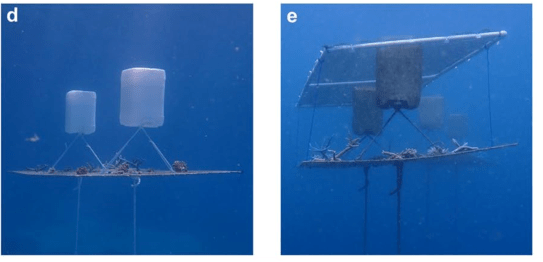
The team installed eight mid-water coral nurseries at two sites on Opal Reef, part of the northern Great Barrier Reef. Four treatments were tested: nurseries left shallow (4 meters) or lowered deeper (7 meters), each with and without a 30% shade cloth. Over 138 days, the researchers monitored coral health—tracking paling (a sign of bleaching) and survival—across more than 300 coral fragments from several key species.
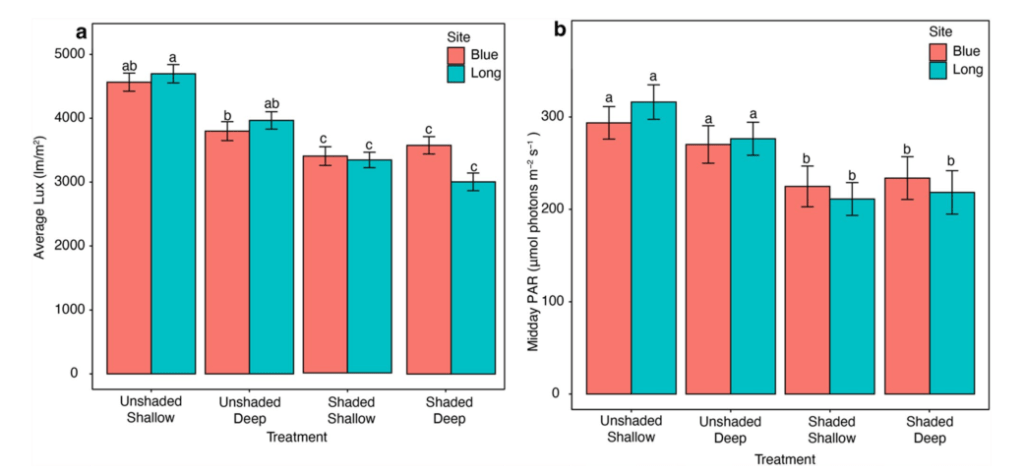
The results were striking. While shading reduced light by up to 36%, it did not significantly reduce coral paling or mortality at either site. In contrast, lowering nurseries to deeper water made a clear difference—at one site, Blue Lagoon, corals in deeper nurseries had the highest survival rates (up to 100%) and showed far less paling than their shallow-water counterparts.
- At Blue Lagoon, deep nurseries (7 m) saw up to 100% survival, compared to just 66% in shallow, shaded nurseries.
- Shading reduced incident light by 25–36%, but did not lead to improved coral color or survival.
The researchers concluded that, during this event, excess light was not the main driver of bleaching—temperature and possibly other site-specific factors played a bigger role. “Our results suggest practitioners should first consider lowering coral nurseries where possible ahead of predicted bleaching conditions as this may provide a low-cost, low-effort benefit,” the authors write.
The study does have caveats. The shading intervention used only a 30% shade cloth, and the timing of installation may have missed the optimal window for protection. Some species were underrepresented, and local conditions—like water flow and salinity changes after a cyclone—may have influenced results. The authors caution that what works at one site may not work elsewhere, and more research is needed to test different shading regimes and depths under varied conditions.
As the world scrambles to safeguard coral reefs, this study offers a practical takeaway: sometimes, the simplest interventions—like moving nurseries deeper—can make a real difference, especially when light is not the main stressor. But it also underscores the need for tailored, site-specific strategies and ongoing experimentation. As restoration efforts ramp up globally, understanding the interplay of heat, light, and other local factors will be key to giving reefs their best shot at survival
References:
Study:
Strudwick, P., Suggett, D.J., Edmondson, J., & Camp, E.F. (2025). Assessing protective shading and lowering of coral nurseries during a mass bleaching event on the Great Barrier Reef. Coral Reefs. https://doi.org/10.1007/s00338-025-02665-2
Further reading:
Hughes, T.P., et al. (2018). Spatial and temporal patterns of mass bleaching of corals in the Anthropocene. Science, 359(6371), 80–83.
NOAA Coral Reef Watch (2024). Satellite coral bleaching degree heating week product.
Peixoto, R.S., et al. (2024). The critical role of coral reef restoration in a changing world. Nature Climate Change.
 The Science Spotlight