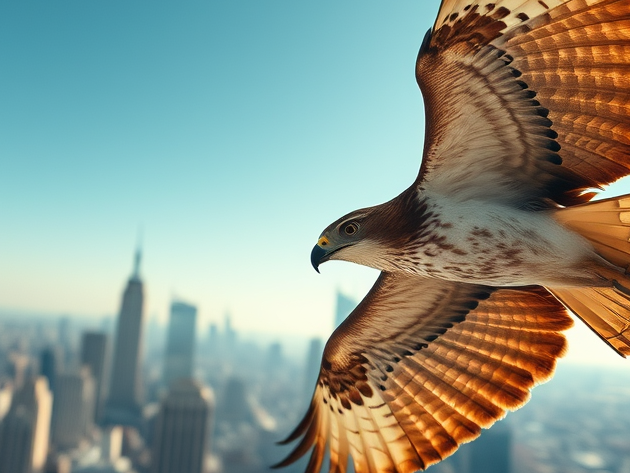
A new study unveils another example of how animals alter their behaviour in response to human activity, this time, in the urban environment. The evolving relationship between humans and nature is endlessly intriguing.
A young Cooper’s hawk in New Jersey has been observed using an extraordinary hunting tactic: it uses car queues at a busy intersection as cover to stealthily approach its prey. This clever bird times its attacks by listening to pedestrian crossing sound signals, which predict longer red lights and thus longer lines of cars, providing perfect concealment for the hawk’s ambush.
This remarkable finding reveals a new level of cognitive sophistication in urban-dwelling raptors, highlighting how wildlife can adapt to and exploit human-made environments in unexpected ways. It also sheds light on broader implications for animal intelligence and urban ecology, showing how species can thrive amid city challenges by developing novel behaviors.
The study was conducted by Vladimir Dinets, affiliated with the University of Tennessee and Rutgers University, and was published in May 2025 in the journal Frontiers in Ethology.
Dinets carried out systematic observations over 18 days between December 2021 and March 2022 at a street intersection in West Orange, New Jersey. The site featured a busy Main Street and a quieter Side Street where small flocks of birds gathered to feed on leftovers left by residents. The hawk’s behavior was monitored visually from a parked car during weekday mornings, focusing on how it used the traffic patterns and pedestrian crossing signals to time its attacks.
The immature Cooper’s hawk was seen perching in a tree near the intersection, waiting for the pedestrian crossing sound signals to activate. These signals indicated that the red light would last longer, causing a queue of cars to form and stretch along the street. The hawk then used this queue as a moving shield, flying low and weaving between the cars to approach the feeding birds unseen. Over 12 hours of observation, six attack attempts were recorded, with at least one confirmed successful kill. The hawk’s timing was not random—the sound signals were active only about 3.75% of the time, yet the hawk appeared at the perch precisely when they were on, demonstrating a sophisticated understanding of the connection between human traffic cues and hunting opportunity.
As a case study focused on a single individual, the findings are inherently limited by sample size and replication challenges. The hawk’s success rate and whether other individuals use similar tactics remain unknown. Additionally, the observations depended on specific local conditions, such as the presence of pedestrian signals and food leftovers, which may not be generalizable to other urban settings.
This study pushes the boundaries of what we know about raptor intelligence and adaptability. The hawk’s ability to form a mental map of the urban landscape, link auditory signals to traffic patterns, and strategically plan its approach demonstrates cognitive skills previously undocumented in birds of prey. Such intelligence likely contributes to Cooper’s hawks’ success in colonizing cities, environments that are typically hostile to wildlife.
Moreover, this behavior exemplifies how animals can integrate human-created signals into their natural behaviors, offering insights into urban ecology and how wildlife might continue to evolve alongside expanding human infrastructure.The discovery of a Cooper’s hawk using car queues and pedestrian crossing signals as hunting cover is a striking example of animal ingenuity in the face of urban challenges.
Why it matters.
As cities grow, understanding how animals adapt will be crucial for conservation and coexistence strategies. The study highlights the interplay between wildlife and human environments. Similar examples of using urban settings include pigeons using road intersections to guide their way home.
References:
Study:
Dinets, V. (2025). Street smarts: a remarkable adaptation in a city-wintering raptor. Frontiers in Ethology, 4:1539103. doi:10.3389/fetho.2025.1539103
Further Reading:
Rosenfield, R. N., et al. (2018). Urban adaptation in Cooper’s hawks: A review of ecology and behavior. Journal of Raptor Research.
Bonta, M., et al. (2017). Fire-spreading behavior in birds of prey. Science Advances.
Smith, J., & Colbert-White, E. (2023). Cognitive abilities of raptors compared to corvids and parrots. Animal Cognition.
 The Science Spotlight