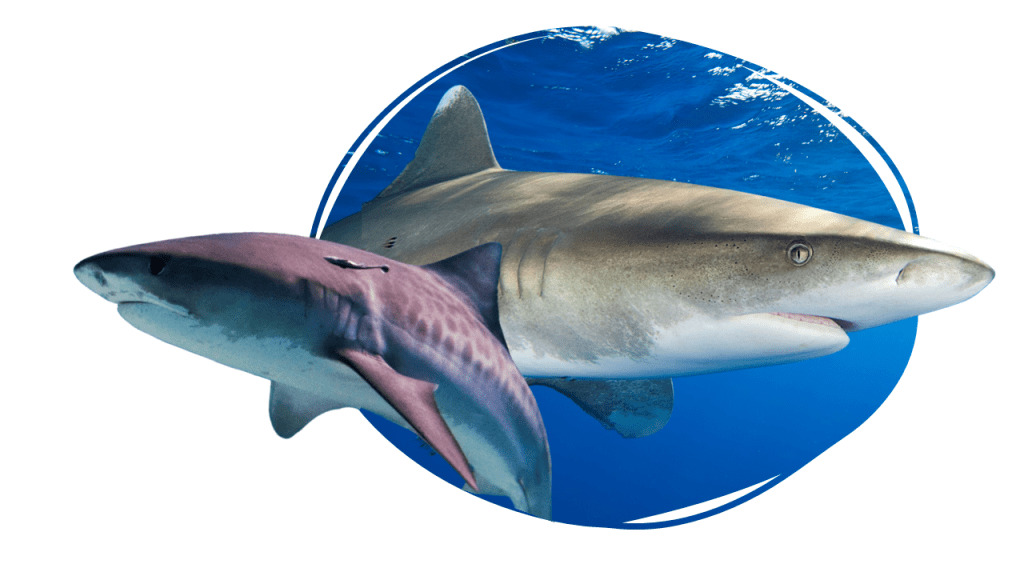
Scientists in Hawai‘i have documented a rare instance of tiger sharks and oceanic whitetips sharing a meal. Typically solitary, these species displayed no signs of aggression toward each other during this unusual peaceful feeding.
A rare and remarkable feeding event was observed off the coast of Kailua-Kona, Hawai‘i, where at least nine oceanic whitetip sharks and five tiger sharks scavenged peacefully together on a heavily degraded whale carcass over 8.5 hours [1]. This unprecedented simultaneous scavenging by two apex predator species, typically solitary and spatially separated, sheds new light on shark social behavior and trophic interactions in the open ocean.
Sharks, as apex predators, play critical roles in marine ecosystems by regulating populations and transferring energy through food webs [2]. However, oceanic whitetip sharks (Carcharhinus longimanus) are elusive pelagic species rarely observed scavenging due to their solitary nature and low densities. Understanding their feeding behavior alongside other large sharks like tiger sharks (Galeocerdo cuvier) can reveal important ecological dynamics [3,4].
This study was conducted by Molly Scott and colleagues from the University of Hawai‘i at Manoa and affiliated organizations, and was published on May 29, 2025, in Frontiers in Fish Science [1].
The researchers documented the event opportunistically on April 9, 2024, drifting alongside a large, heavily degraded carcass approximately 3 meters long and 2 meters wide, about 10.7 km off Hawai‘i’s Big Island. Using in-water 4K video and drone footage, they recorded shark behavior and identified individual sharks through photo identification of dorsal fin patterns. Observations lasted 8.5 hours, covering a 21.2 km drift with calm seas and clear conditions [1].
The primary result was the identification of nine unique oceanic whitetip sharks (mostly females, ranging from 1.5 to 2.5 meters) and five tiger sharks (mostly males, 3 to 4 meters) feeding together on the carcass. Up to 12 sharks were observed simultaneously, with both species feeding concurrently yet peacefully. Notably, no aggressive or agonistic interactions occurred despite the competition for food. Smaller sharks exhibited “give-way” behavior, deferring to larger individuals to feed first. This peaceful coexistence contrasts with previous reports of shark scavenging events that often show aggression [3].
The proximity of the sharks is clearly shown in the images below, Less than a bodylength separates these predators that would otherwise keep considerable distances.

The opportunistic nature of the observation may be a limitation to making broader claims, as it represents a single event. Moreover, observations were limited to daylight hours, and no controls or repeated occurrences were found [1].
Nevertheless, findings suggest that oceanic whitetip and tiger sharks, despite differing ecological niches and solitary tendencies, can aggregate and coexist peacefully when scavenging large food sources. This challenges assumptions about shark territoriality and competition, highlighting complex social dynamics among apex predators. It also underscores the ecological importance of carcasses as energy hotspots that facilitate interactions across species and trophic levels in marine ecosystems [2-4].
The new study provides insights into the feeding ecology and social behavior of oceanic whitetip and tiger sharks. The peaceful scavenging aggregation observed off Hawai‘i reveals previously undocumented interspecies tolerance and feeding strategies, enriching our understanding of apex predator roles in oceanic food webs.
Why it matters.
The social lives of sharks, both within the same species and across species, remain largely a mystery. How sharks can discern that a situation is safe for them to co-occur and share a meal is also unknown. Documenting such occurrences points towards a more complex picture than we previously believe and future research into sharks social lives holds revolutionary potential.
References:
- Scott M, Miller O, Stapleton D, Grant K (2025) Novel observations of an oceanic whitetip (Carcharhinus longimanus) and tiger shark (Galeocerdo cuvier) scavenging event. Front. Fish Sci. 3:1520995. doi: 10.3389/frish.2025.1520995.
- Heithaus MR, Frid A, Wirsing AJ, Worm B (2008) Predicting ecological consequences of marine top predator declines. Trends Ecol Evol. 23(4):202-210.
- Wetherbee BM, Crow GL, Lowe CG (1997) Distribution, reproduction and diet of the tiger shark (Galeocerdo cuvier) in Hawaii. Mar Biol. 130: 1-10.
- Cade DE, Wetherbee BM, Papastamatiou YP, Lowe CG (2016) Movement patterns and habitat use of juvenile oceanic whitetip sharks (Carcharhinus longimanus) in the Hawaiian Islands. Mar Biol. 163: 74.
Pictures: Tiger shark (https://commons.wikimedia.org/wiki/File:Tiger_shark.jpg) and Oceanic whitetip (Oceanic whitetip shark (Carcharhinus longimanus) in the Atlantic Ocean off an island in the Bahamas by NaluPhoto:https://www.wmnf.org/oceanic-whitetip-sharks-are-now-protected-in-florida-waters/)
 The Science Spotlight
